Skip to content
HannoverGerman Citizenship
What we do

Records, files, and following the case through

A German citizenship application is decided on documents. Most of the work is finding them, proving that they connect, and presenting them in the form the German authority requires.

Archive research

We search for the records a family line needs, in Germany and in the Americas: civil registers, parish books, emigration lists, passenger records, consular registers, naturalization files. Where a record does not exist, we look for what can stand in its place.
Genealogical reconstruction

The line is documented birth by birth, from the German ancestor down to the applicant, so that each link is proved rather than asserted. Gaps are identified early, while there is still time to work on them.

Certificate of citizenship

The Staatsangehörigkeitsausweis is the document that establishes that someone is a German citizen. We prepare and file the application with the Bundesverwaltungsamt and follow it through.

Restitution files

Applications under Article 116 (2) of the Basic Law and under §§ 5 and 15 StAG, including the historical research needed to establish the deprivation of citizenship and its ground.

Translations, apostilles and legalizations

Foreign documents must reach the German authority in German, translated by a sworn translator, and often apostilled. We coordinate that work and check the result before it goes into the file.

Birth and marriage registration in Germany

Once citizenship is recognized, births and marriages that took place abroad can be entered in the German register at Standesamt I in Berlin. We prepare and file those applications.

Name declaration

German law often requires a declaration on the surname after citizenship is confirmed, particularly where foreign naming rules differ. We prepare it.

Passport and identity card

With citizenship recognized, we help you assemble what the German consulate requires for a first passport or identity card, and explain how the appointment works.

German fees

Administrative fees, archive fees and register fees in Germany are paid from Germany, so you do not need an account there or an international transfer for every small charge.

From our files

What these procedures produce

Documents from files of this office, with personal data blacked out. Each one is the instrument that its own procedure ends in, and not an illustration chosen for effect.

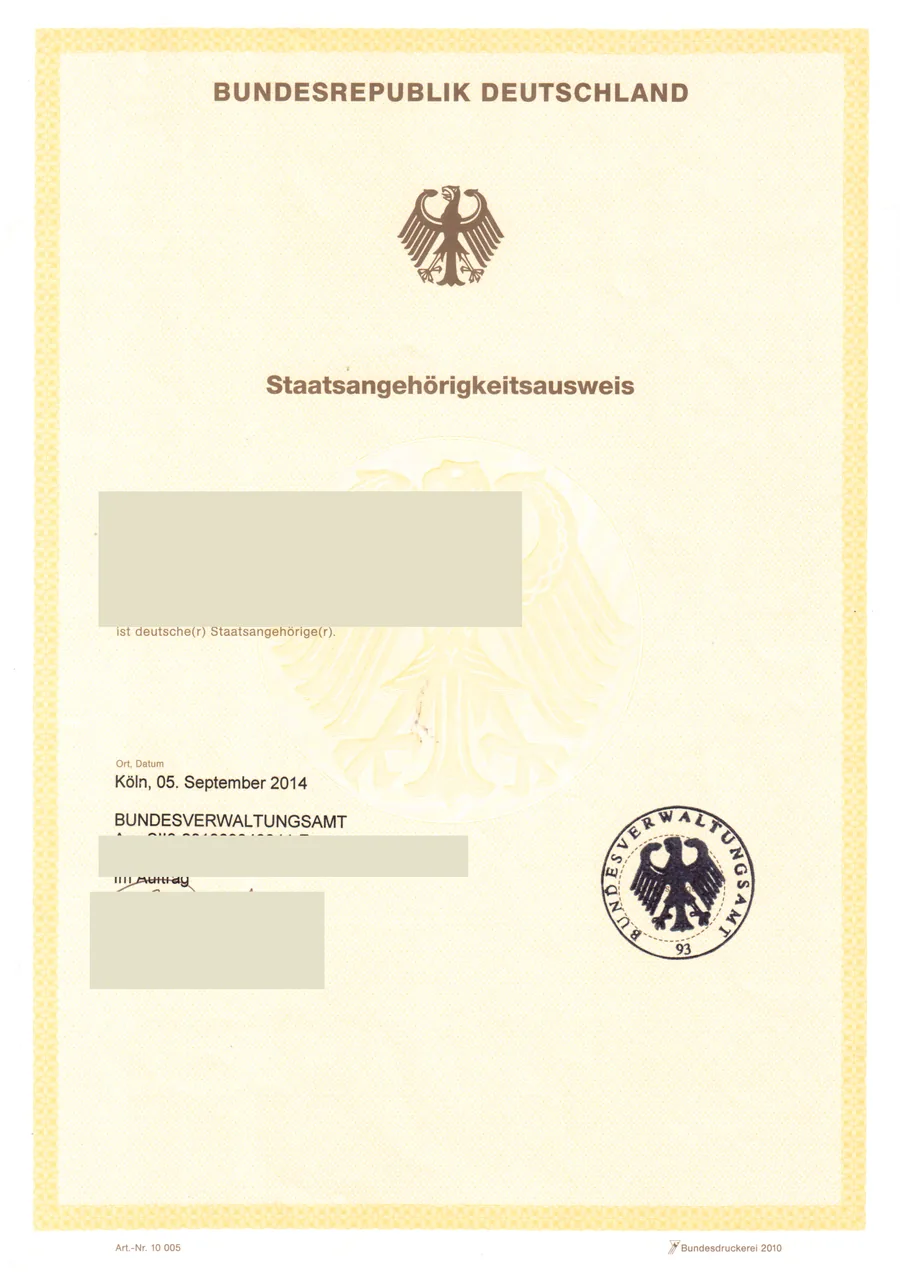
Certificate of German citizenship issued by the Bundesverwaltungsamt in Cologne, 2014, with personal data blacked out
Staatsangehörigkeitsausweis, Bundesverwaltungsamt, Cologne 2014. The end of a determination procedure under § 30 StAG: it does not grant citizenship, it establishes that it already existed.
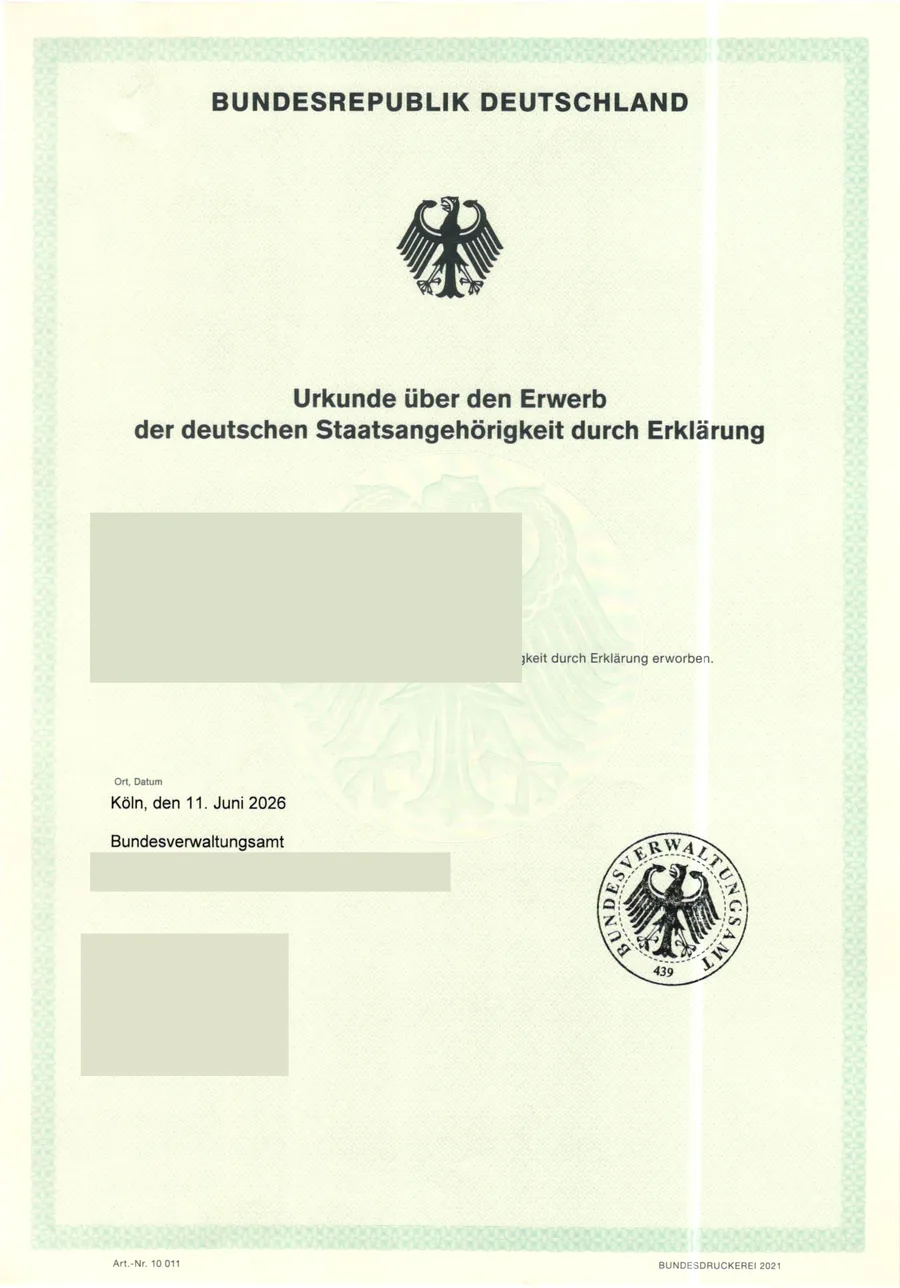
Certificate of acquisition of German citizenship by declaration, Bundesverwaltungsamt 2026, with personal data blacked out
Acquisition by declaration under § 5 StAG, Bundesverwaltungsamt, Cologne 2026. One of the two routes created in August 2021, and the one with a deadline: 19 August 2031.
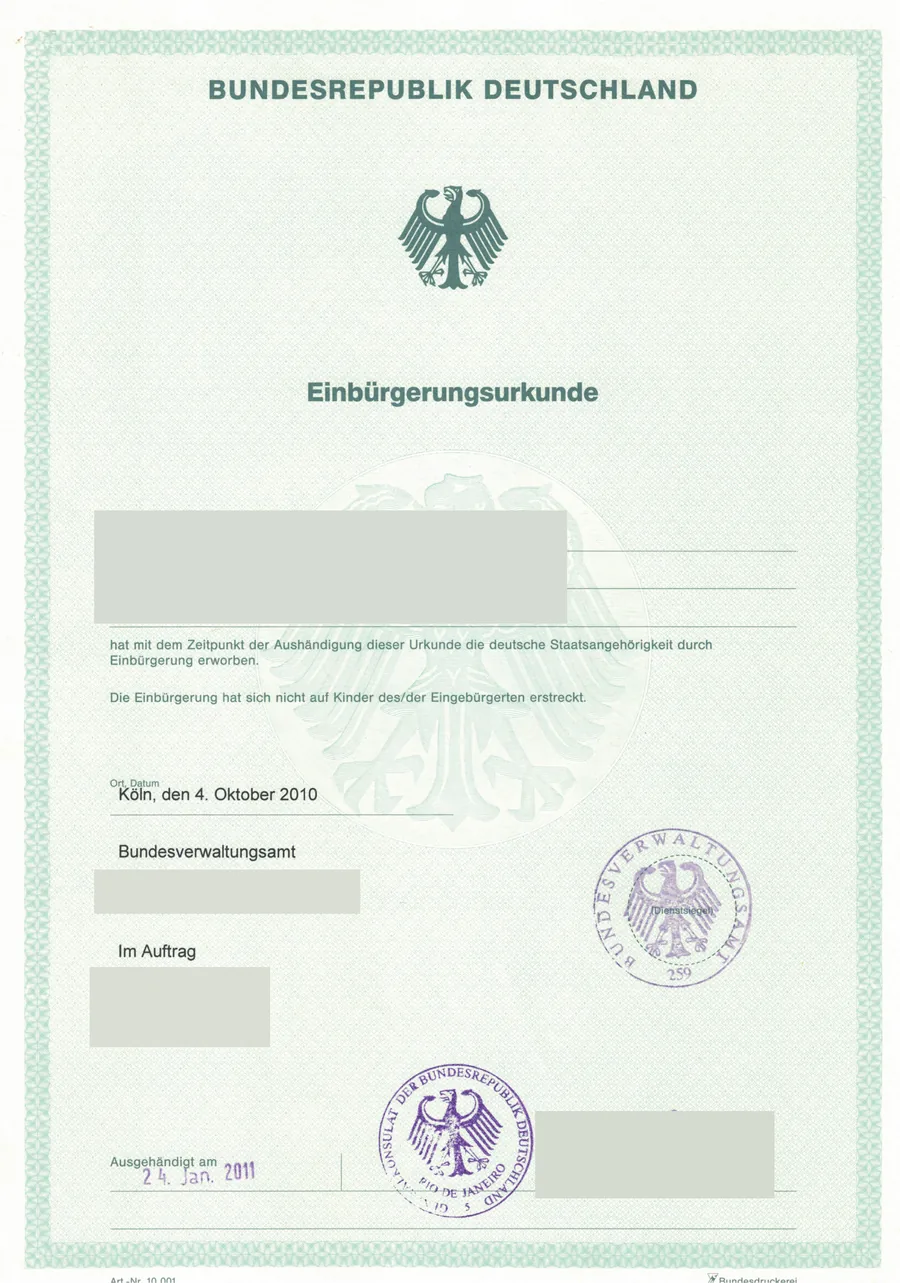
German naturalization certificate, 2010, with personal data blacked out
Einbürgerungsurkunde, 2010. The instrument issued in restitution cases, including those decided under Article 116 (2) of the Basic Law.
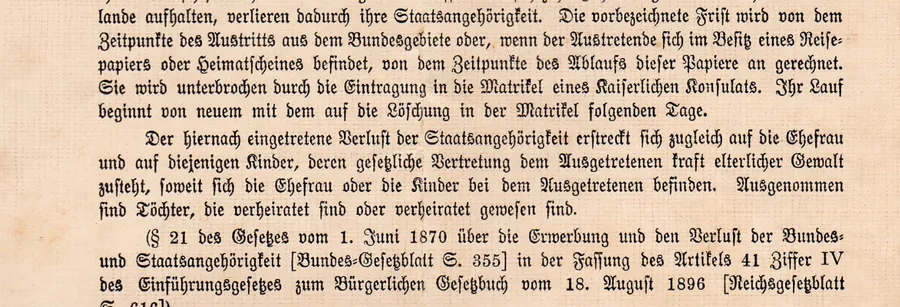
Section 21 of the 1870 nationality act printed in Fraktur at the foot of a 1910 Heimatschein
§ 21 of the nationality act of 1870, printed in Fraktur at the foot of a Heimatschein of 1910: ten uninterrupted years abroad ended citizenship, and registration in the consular register interrupted the period. This is the source of the rule quoted on our home page, not an illustration of it. No personal data appears on it.
And the law itself

Who examines the law in your file

Where a file turns on a question of German nationality law, which provision applies, whether a loss occurred in 1908, whether a declaration under § 5 StAG is still open, that question is examined by Fabio Werlang, a European lawyer admitted in Portugal and Brazil. Any submission to the German authority that argues a point of law is his work.

The company does the document work around it: the research, the records, the translations, the filing and the follow-up.

Who does what, in detail

Start with a document review

Tell us about your German ancestor. We will look at what records your family line would require and whether those records can be reconstructed, and we will tell you what the next step would be.

The form opens on an external service (ClickUp), which is where our case files are kept. There is no charge for the document review.